
Past Events

GEOGRAPHIES OF POPULATION HISTORY: EAST ASIA + SOUTH ASIA
The Centre is hosting four stellar scholars of reproductive politics in Asia. As part of these visits, we are organizing a series of talks and workshops in which we discuss population in the Asian imagination. By examining topics like fertility control, family size, contrapcetives and their popular imprints, we see how they were interpreted according to specific regional dynamics. Each of the Asian states planned their demographic interventions on assumedly universal categories and terms but with very different outcomes. Through the series, we understand how geography informs population dynamics and historical state transformations.
This Visiting Scholars Series will take place from 12 Aug – 15 Sep 2024.

HOW DO WE THINK ABOUT POPULATION IN THE ANTHROPOCENE?
The interdisciplinary research group who first described a “Great Acceleration,” c. 1950, produced a suite of now-famous graphs depicting large-scale socio-economic changes. Significantly, the first displays world net population growth. In subsequent analysis of the Anthropocene, however, stark late modern changes in human fertility, mortality, ageing, and consumption have probably been the least discussed of all the variables. This is one measure of the highly successful critique of the problematisation of population. This small meeting brings key scholars of the Anthropocene, of population, of reproductive justice and of political ecology and economy together. How do we think about population in the Anthropocene?
This Conference will be held at Jesus College, Cambridge, UK from 2 – 4 July 2024.
Populating the 1980s: A Decade Revisited
Historiography on population management in the 1930s-70s has been diverse and multifocal. Stemming from a discursive critique of Malthusianism in its various forms, this literature links coercion and calculated consent from South Asia to the Americas. The 1980s present a new query…
This online seminar series ran from 29 March 2023 – March 2024. View the seminar program via the Populating the 1980s event page.

Pacific Populations: Fertility, Mortality and Movement in Colonial Oceania – Speaker Series and Workshop
An increasing global population has characterized modern world history, but the view from the Pacific urges an interrogation of this trend. This workshop, hosted by Laureate Centre for History & Population at UNSW, will bring together scholars whose research investigates the vexed histories of depopulation in nineteenth and early twentieth-century Oceania. As global climate change renders issues of migration, land, and population increasingly urgent across the Pacific World, the workshop offers an important and timely reconsideration of the decline of Pacific populations during colonial rule… Pacific Populations Seminar Schedule
9 August 2022 – 9 May 2023.
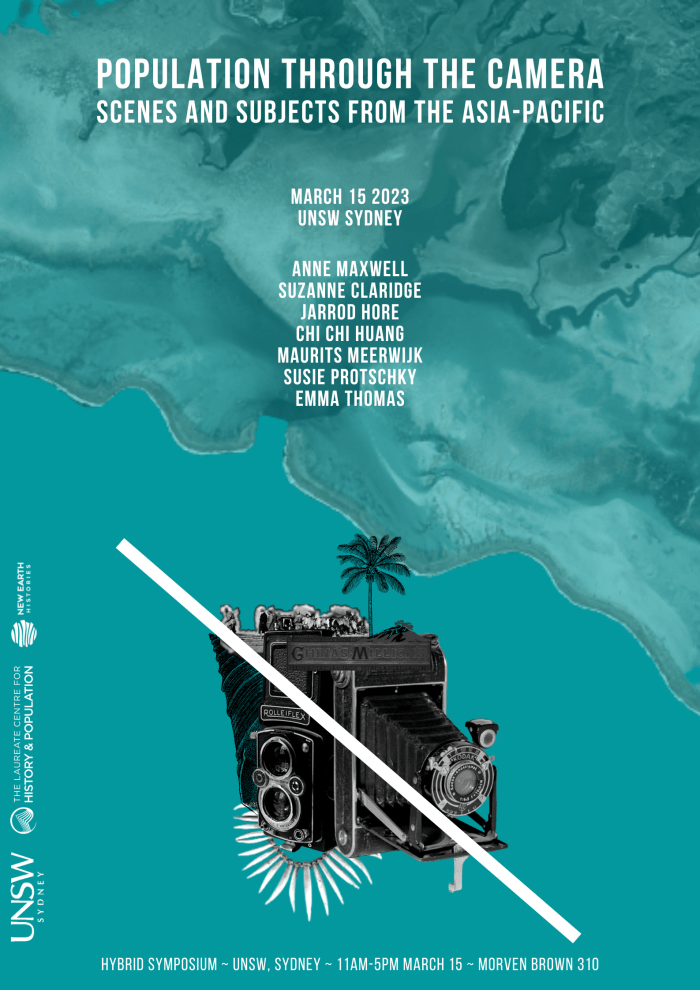
Population Through the Camera: Scenes and subjects from the Asia-Pacfic
Population Through the Camera Event Webpage
This symposium brings scholars together to discuss populations within the history of photography, make sense of their presence or absence, and consider the linked spatialities and intimacies of landscape, documentary, and portrait views. We suggest that there is an unexplored modern visual economy of population, observable in the products of one of modernity’s signal technologies: the camera. With a focus on the Asia-Pacific, where modern histories of population transfer, colonialism, and photography overlap in ways that have escaped critical attention.
15 March 2023

The Huxleys: Revolutionising science, nature and culture @ The Royal Institution, London
In the 19th and 20th centuries, the Huxley family profoundly reshaped how humans think about themselves and their effect on this planet. Join Alison Bashford, in conversation with Adam Rutherford, as they explore three generations of Huxleys. From their scientific achievements to what went on in their private lives. In this conversation, discover these celebrated scientists that covered the fields of genetics, animal behaviour, ecology, psychology and more. Copies of Alison’s latest book, ‘An Intimate History of Evolution: The Story of the Huxley Family’, will be available to purchase at the end of the talk.
10 October 2022, 7-8.30pm (London), The Royal Institution.

Rethinking Population in an Age of Revolution
Rethinking Population in an Age of Revolution invites scholars interested in this revolutionary moment of the late eighteenth and early nineteenth centuries to examine how emergent ideas of statecraft, population and empire took expression on both sides of the Mediterranean and across the globe.
Rethinking Population in an Age of Revolution event recap
23-24 June 2022, UNSW Sydney.

Historians on Planetary Futures, 2021-2022 Seminar Series
Historians on Planetary Futures Videos
The historians in this series bring a set of concerns and questions that broaden and deepen our collective conversations about possible futures of the planet Earth and the entanglement of such visions with the viability of human habitation. What pasts prefigure planetary futures? How have planetary futures been produced and reproduced by discrete projects of world-making? When and why do planetary futures revolve around the question of human population?
8 Feb – 11 April 2022, Online.

Samuël Coghe, Population Politics in the Tropics
Abstract: From the 1890s, a devastating epidemic of sleeping sickness and shifting views on the colony’s ‘native’ population triggered mounting anxieties of depopulation among colonial officials in Angola, Portugal’s long-standing and arguably most important colony in Africa. Population Politics in the Tropics traces this depopulation discourse through the first half of the twentieth century, showing how it was constantly reiterated by alarming reports about other deadly diseases, low fertility, high infant mortality, endemic labour scarcity and rampant emigration… Read the full abstract on the Laureate Centre Seminar Webpage.
Laureate Centre Seminar: 6 April 2022, 6-7pm, Zoom.

Nicole Bourbonnais, “The Gospel of Family Planning”
Abstract: In the early 20th century, rising population growth rates in the decolonizing world became a subject of international concern and intervention for a variety of actors, from feminists to eugenicists to neo-Malthusians. Recent studies have explored the consolidation of a “population establishment” in the post-WWII period: a cohort of demographers and other experts (primarily men) tasked with advising dwindling colonial empires and emerging nationalist governments on how best to reign in their populations in the name of economic development and global security… Read the full abstract on the Laureate Centre Seminar Webpage.
Laureate Centre Seminar: 2 March 2022, 6-7pm, Zoom.

External: Cambridge Reproduction Forum – The Past, Present and Future of Contraception
Supporters of the Laureate Centre may be interested in this year’s Cambridge Reproduction Forum. The forum will explore the origins and methods of contraception from a historical, sociological and scientific perspective. This forum aims to inspire and reinforce the commitment to prioritise modern contraception programmes and research based on a multidisciplinary understanding of the history and future directions of family planning and contraception. Speakers: Kim Alexander, Dr Aprajita Sarcar, Alice Pelton, Dr Beth Sundstrim and Professor Cara Delay, Stefanie Felsberger.
10 Feb 2022, 2pm (London time), Zoom
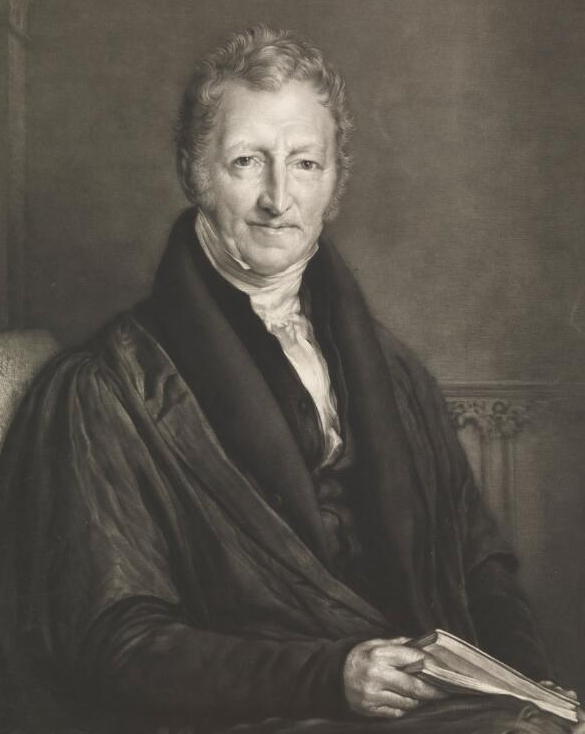
External: Noel Butlin Lecture – Alison Bashford, Gender and Classical Political Economy
In this lecture, I re-read Malthus’s Essay on the Principle of Population and his Principles of Political Economy with the aim of understanding his inclusion of materials on what we call ‘gender’. Historical analysis of gender has energised my conceptual and substantive work for many decades now, but increasingly it does so at an empirical level as much as a conceptual or political one…
Keep Reading Abstract
…That is, I am struck simply by the fact that past historical actors and thinkers considered gender far more often and fully than almost all subsequent analysts of them. It is therefore not just insufficient, but an empirical error, not to inquire into how ‘men’ and ‘women’ were considered, constructed, instructed, symbolised or valued in this canon. Classical political economists and their ‘universal historian/stadial theory’ predecessors especially of the Scottish Enlightenment considered gender routinely, even if in terms with which we would now disagree. I argue that the political economy canon was originally gendered (and comparatively so) because it so often sought a world history of population change, via stadial theory.
11 Feb 2022, 3.45-5.20pm (Sydney Time), Zoom

Aprajita Sarcar, “The Family Within a Triangle: The creation, circulation and afterlife of a family planning campaign”
The paper explores the visual artefact that represented the national family planning programme in India: Hum Do Hamare Do (We are Two, will have Two Children), created in 1967. It consisted of a couple with two children: a boy and a girl in an inverted triangle. The inverted red triangle, simultaneous to the campaign, became the symbol of the international family planning movement… Read the full abstract on the Laureate Centre Seminar Webpage.
Laureate Centre Seminar: 8 December 2021, 6-7pm, Zoom

AHA Keynote: Alison Bashford, “How do we think about population in the Anthropocene?”
This lecture expores first how modern (post c. 1780) population changes have entered discussion on the Anthropocene. Secondly, it asks how historians specifically, might (not should) begin to answer this question, with attention both to accelerating global net population growth and local population decline, caused amongst other dynamics by the fertility, mortality, and migration impacts of colonisation.
1 December 2021, 5pm, Zoom

Andrew Moeller, “Be Fruitful and Multiply? Anglican Justifications for Fertility-Manipulation Schemes in Interwar England”
In 1930, the Church of England became the first major Christian denomination in Europe or North America to formally condone the use of birth control. The Bishop of Winchester, Theodore Woods, led the reform campaign, and he did so for the expressed purpose of encouraging an increase in the birthrate amongst the English middle and upper classes. Drawing upon Woods, this paper explores the moral logic offered by Anglican leaders on behalf of their widespread efforts to manipulate both the ‘quantity’ and ‘quality’ of the English population during the interwar period… Read the full abstract on the Laureate Centre Seminar Webpage.
Laureate Centre Seminar, 3 November 2021, 6-7pm, Zoom

Tina Johnson, “100 Years of China’s Population Strategies: From Sanger to the Three-Child Policy”
2022 marks the 100th anniversary of Margaret Sanger’s first visit to China. Her visit prompted public discussions of birth control in the service of improving China’s population that continue to the present day. These conversations and subsequent policies expanded to include many aspects of reproductive health like screenings for sexually transmitted infections and cervical cancer. They also corresponded with conflicting policies through the 1960s, as (primarily) women’s calls for more control over reproduction clashed with paternalistic pronatalism… Read the full abstract on the Laureate Centre Seminar Webpage.
Laureate Centre Seminar: 6 October 2021, 6-7pm, Zoom
External: Alison Bashford, “Works that Shaped the World: Malthus and the Modern World”
As the planet approaches 8 billion, international debate on population will be ignited again, and as with 7 billion, 6 billion and 5 billion, discussion will still circle around Thomas Robert Malthus and his Essay on the Principle of Population (1798). Why does a controversial text from the classical political economy canon, and from a pre-industrial time, endure as a touchstone? Malthusian ideas and their discontents have endured as a policy benchmark. They have done so across massively diverse global polities, cultures and languages (India, China, Japan, Australia), for leaders and policymakers across time (Nehru, Mao, Deakin), and for the world’s key global thinkers (Mill, Marx, Keynes). But this is not just a matter of the past. Humanities Research Centre, ANU, 30 September 2021, 5pm, Zoom

External: Alison Bashford, “The Intimate History of Evolution: The Huxleys, 1825-1975”
At Life Magazine’s 1947 photoshoot, Julian Huxley self-consciously arranged himself in front of a portrait of his grandfather, Thomas Henry Huxley. In the foreground, a well-known mid-twentieth century science writer, zoologist, conservationist—that generation’s David Attenborough. In the background, a mid-nineteenth century natural scientist – Darwin’s most outspoken spokesman. Between them, Thomas Henry Huxley (1825–1895) and Julian Huxley (1887–1975) communicated to the world the great modern story of the theory of evolution by natural selection. Together, they were ‘trustees of evolution’, a phrase that Julian Huxley often used to describe all of humankind, but which I use to describe the Huxleys themselves.
4 August 2021, 6.30pm, Zoom

External: 2021 Dan David Prize Award Ceremony – Prof Alison Bashford
Professor Alison Bashford, Director of the Laureate Centre for History & Population, will be officially recognised for her wide-ranging work on public health, medicine, disease control, borders, and quarantine on Sunday the 9th of May. Professor Bashford will accept her award alongside Prof. Katherine Park, Prof. Keith Wailoo, Dr. Anthony Fauci, Prof. Zelig Eshhar, Dr. Carl June, and Dr. Steven Rosenberg.
The broadcast of the award ceremony will begin at 6pm BST (London), 1pm EST (New York), and 10am PST (Los Angeles). For those in Asia the ceremony will begin at 10.30pm IST (New Delhi), 1am CST (Beijing and Hong Kong), and 3am AEST (Sydney).
9 May 2021, 6pm BST, Zoom